

Internet of Things (IoT) technology has revolutionized the automotive and transport sectors. This is accelerated by 5G wireless communication. Industry 4.0 and IoT significantly boosts the market for connected and autonomous vehicle. The basis of 5G technology is basically the guarantee of ultra-high speed data transfer and minimal latency, which results in faster response times and improved reliability
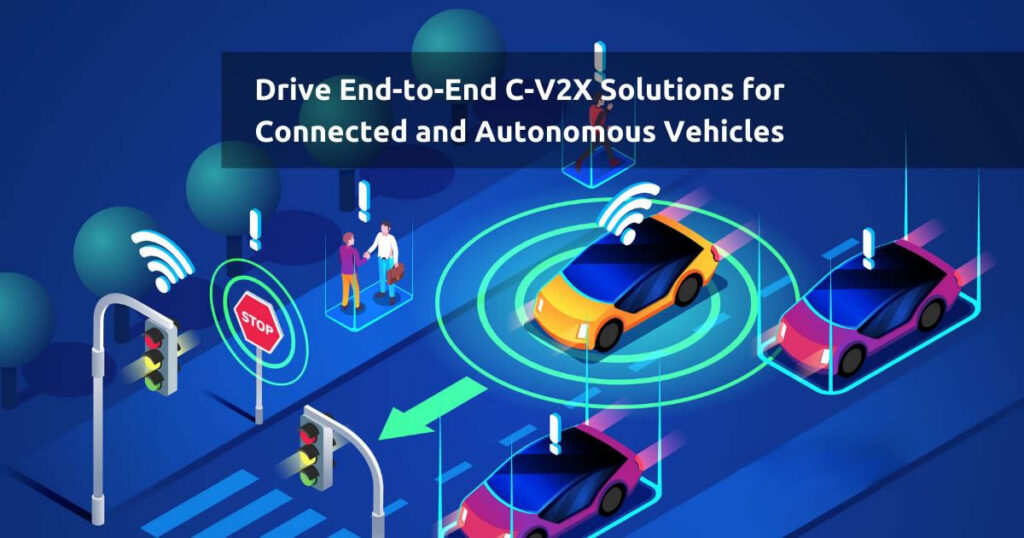
Vehicle manufacturers use the Internet of Things (IoT) to link to cellular networks for real-time navigation, driving aids, integrated entertainment, and emergency services. The use of 5G would greatly accelerate the development of applications like autonomous driving, Vehicle-2-Vehicle (V2V), Vehicle-2-Infrastructure (V2I), Vehicle-2-Network (V2N), and Vehicle-2-Pedestrian (V2P) communications. A Vehicle-to-Everything (V2X) ecosystem may be made possible by 5G’s reliability, availability, speed, and lower latency. The automotive industry is the largest market for 5G IoT solutions.
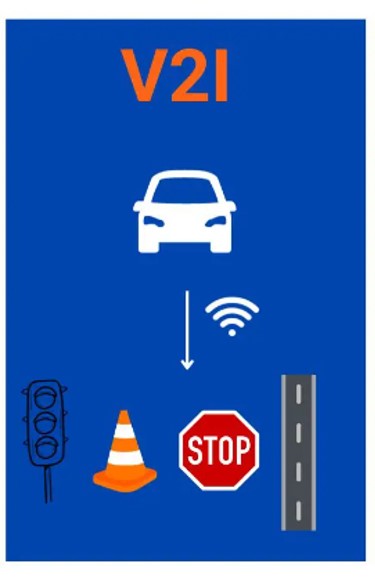
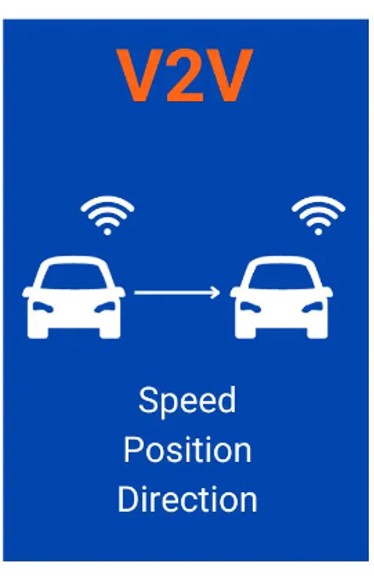
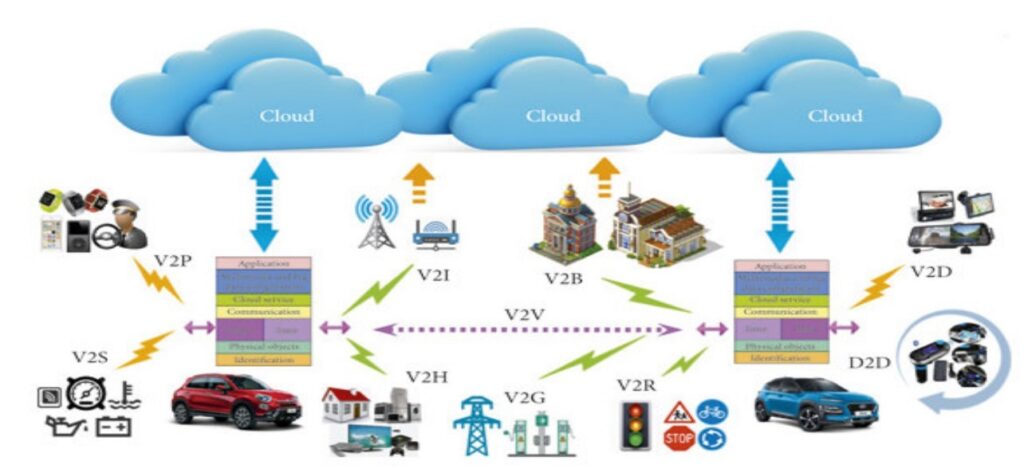
IoV is an expanded use of IoT for smart transportation. It is intended to serve as a crucial platform for the collection, processing, and analysis of data for intelligent transportation systems. A vehicle will function as a sensor platform, absorbing data from the outside world, from other moving objects, and from the driver and utilising it for traffic management, pollution reduction, and safe navigation. The Internet of Vehicles (IoV) consists of vehicles that communicate with each other as well as with handheld devices carried by pedestrians, roadside units (RSUs), and the public networks using V2V (vehicle-to-vehicle), V2R (vehicle-to-road), V2H (vehicle-to-human) and V2S (vehicle-to-sensor) interconnectivity thereby creating a social network where the participants are intelligent objects rather than the human beings.
A typical IoV architecture consists of three layers:
1· Perception layer: This layer contains all the sensors within the vehicle that gather environmental data and detect specific events of interest such as driving patterns and vehicle situations, environmental conditions, etc. It also has radio frequency identification (RFID, satellite positioning perception, roads environment perception, vehicle position perception, car and objects perception, etc.
2· Network layer: This is the communication layer that ensures connectivity to communications networks such as GSM, G5, WiMax, WLAN, Wi-Fi, and Bluetooth. It supports different wireless communication modes such as Vehicle-to-Vehicle (V2V), Vehicle-to-Infrastructure (V2I), Vehicle-to-Pedestrian (V2P). and Vehicle-to-Sensor (V2S).
3· Application layer: This layer includes statistics tools, support for storage, and processing infrastructure. It is responsible for storage, analysis, processing, and decision making about different risk situations such as traffic congestion, bad weather, etc. It represents smart applications, traffic safety, efficiency, and multimedia-based infotainment.
IoV has diverse applications:
· Safe driving: This refers to cooperative collision avoidance systems that use sensors to detect imminent collision and provides warning to the driver. This application involves periodical status messages and emergence messages. An emergency message is triggered by emergence event such as traffic jam, accident, bad road condition.
· Traffic control: IoV will bring about fundamental changes to urban congestion management, transport and logistics, urban traffic, and our collective lifestyle.
· Crash Response: Connected cars can automatically send real-time data about a crash along with vehicle location to emergency teams. This can save lives by accelerating emergency response.
· Convenience Services: The ability to remotely access a car makes possible services such as remote door unlock and stolen vehicle recovery. Connected car technology can provide transportation agencies with improved realtime traffic, transit, and parking data, making it easier to manage transportation systems for reduced traffic and congestion.
· Infotainment: Connected cars can provide online, in-vehicle entertainment options that provide streaming music and information through the dashboard.